I have a question. Imagine one person is eating instant ramen, hot dogs, and ice cream, while another person is eating whole-grain bread, meat, rice, and strawberry pudding. Which meal is not ultra-processed?
Well, that is actually a trick question. Some foods in both meals could be ultra-processed, depending on how they were made and what ingredients were used. Ultra-processed food usually goes through many industrial steps and often contains ingredients that people would not normally use in a kitchen. Instant ramen is an obvious example, but even foods that look healthier can sometimes be highly processed. This shows how quietly processed food has sneaked into everyday life.
So, is ultra-processed food always bad? Not necessarily, but I do not think we should eat too much of it. The problem is that avoiding it completely can be extremely difficult. Ultra-processed foods are often cheaper, faster to make, easier to store, and easier to sell. That is probably one reason they have become such a huge part of modern life. Some foods do not even look much like the ingredients they originally came from. Instead of using a whole potato, for example, a company might turn potato powder into something that tastes and looks like a potato chip.
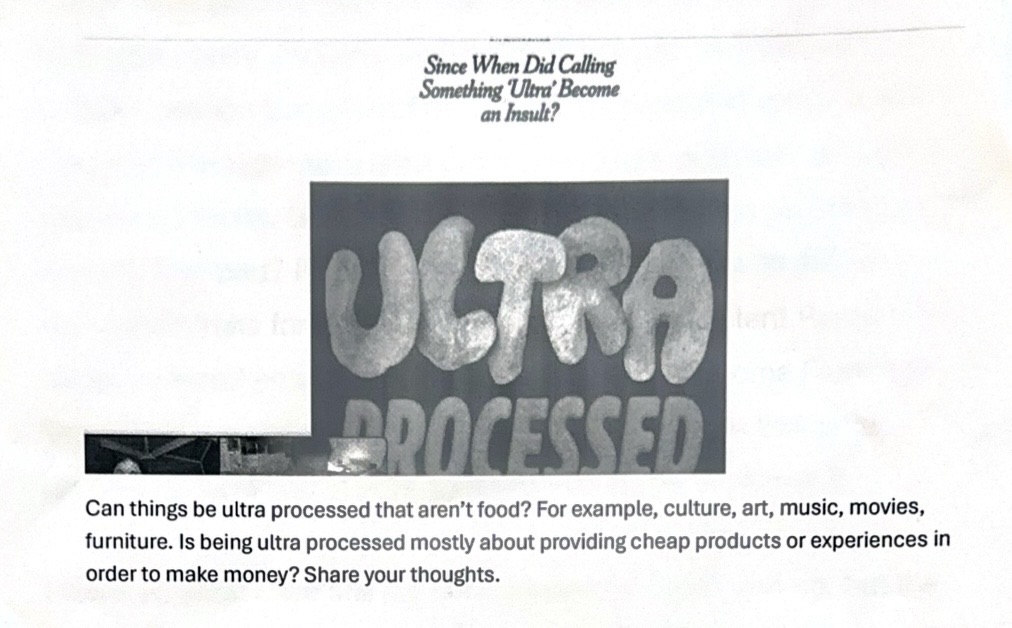
But I think the idea of being “ultra-processed” can go beyond food. Movies, music, art, furniture, and even culture can become ultra-processed too. A movie might be made using the same characters, jokes, action scenes, and endings again and again because studios already know that formula makes money. A song might be designed mainly to become popular online instead of expressing something original. Furniture can be made as cheaply and quickly as possible so people will replace it instead of keeping it for years.
Maybe that is what “ultra-processed” really means. It is not only about changing something many times. It can also mean taking something original and redesigning it to become cheaper, faster, easier to consume, and easier to sell. When that happens, the product may become more convenient, but it can also lose some of its personality, quality, or meaning.
In summary, completely avoiding ultra-processed food is almost impossible today because it is everywhere. The same may be true for ultra-processed culture. I do not think the answer is to reject everything that is processed. Instead, we should pay attention to what we consume, whether it is food, movies, music, or anything else. Sometimes the easiest thing to consume is not always the thing with the most value.



Leave a comment